Smart Privacy Glass: How It Works and What Affects the Price
Smart privacy glass lets a room shift from an open view to a frosted appearance without closing blinds. For businesses, that flexibility can help meeting rooms, private offices, and consultation spaces serve different needs throughout the day.
Before budgeting, separate the price of the glass or film from the cost of the complete installation. Electrical connections, controls, existing glazing, and site access all affect the final amount. This guide explains the technology, its limitations, and what Greater Portland property owners should discuss before requesting a quote.
How Does Smart Glass Work?
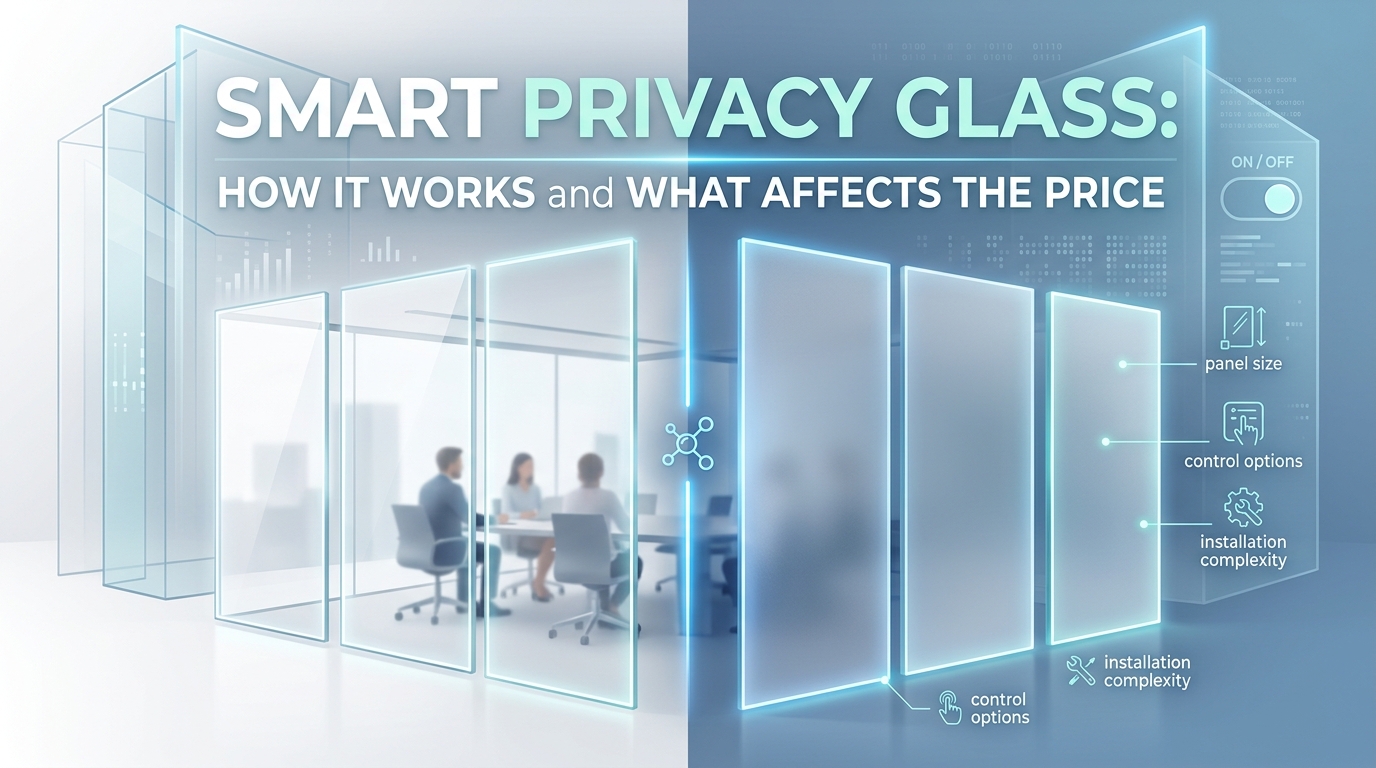
Many switchable privacy glass products use polymer-dispersed liquid crystal technology, commonly called PDLC glass. A thin layer containing liquid crystals changes how light travels through the glazing.
In conventional PDLC systems:
- With power off, the crystals have a random orientation that scatters light, creating a frosted appearance.
- With power on, the crystals align, allowing more light to travel directly through the panel and making it appear clearer.
A compatible power supply and controller operate the system. The switching layer can sit inside laminated glass or attach to suitable existing glass as retrofit film.
Frosted Privacy Has Limits
Frosted PDLC obscures the view while still transmitting light. It does not automatically create darkness, and silhouettes may remain visible under strong lighting. The clear state can also retain haze, particularly when viewed from an angle. Intelligent Glass identifies both limitations in its performance guidance.
Before approving a product, view a working sample under conditions similar to your room. Check it from the hallway, at seated height, and with interior lights on. For sensitive spaces, assess privacy using the actual furniture layout and viewing distances.
Smart Glass vs. Smart Film: Which Should You Choose?
Both options can provide electrically controlled privacy, but they involve different project scopes.
Laminated Switchable Glass
Laminated smart privacy glass contains the switching layer between glass sheets. It is worth considering for new partitions, replacement glazing, or renovations where the existing panels will already be removed. The glass protects the internal film from direct surface contact.
Order the finished panel around verified dimensions, hardware requirements, and wire locations. Manufacturers may prohibit cutting or drilling after production; Smartglass International specifically requires those operations during manufacturing.
Retrofit Smart Film
Adhesive smart film applies to an existing glass surface, making it an option when retaining the current glazing is practical. Gauzy distinguishes this surface application from film sealed inside laminated glass.
Have the installer confirm compatibility with the glass surface, coatings, exposure, and cleaning routine. Film should not conceal unresolved cracks, failed insulating units, or unsuitable glazing. Those conditions need a separate professional assessment.
The practical choice depends on whether you need new glass or primarily need to change the privacy function of sound existing panels.
Where Smart Glass for Offices Makes Sense
Switchable glass is most useful where people regularly alternate between visibility and visual privacy. Gauzy identifies conference rooms, private offices, corridor-facing spaces, and office pods among its applications.
Consider these priorities:
- Meeting rooms: Allow an open appearance between meetings and obscure views during discussions.
- Private workspaces: Give occupants control over visibility without permanently frosting the entire enclosure.
- Flexible shared rooms: Adapt the same space for interviews, focused work, or group sessions.
Switching privacy does not establish soundproofing. If conversations need confidentiality, assess the glass construction, framing, doors, and gaps as a complete enclosure. Intelligent Glass treats acoustic-rated glazing as a separate specification.
For exterior windows, distinguish visual privacy from solar control. Gauzy specifies different technologies and product configurations for office privacy, shading, and temperature control; do not assume every privacy product delivers the same heat-management performance.
Smart Privacy Glass Cost: Published Product Prices
There is no universal smart glass cost per square foot. Product construction and quote inclusions differ, so compare prices only after confirming what each supplier provides.
PriWatt publishes the following supplier-specific product ranges in US dollars:
Product |
Published Product Cost per Square foot |
|
Self-adhesive PDLC privacy film |
65–75 |
|
Laminated PDLC glass |
145–160 |
|
PDLC insulated glass unit |
160–200 |
These figures are one manufacturer’s pricing benchmarks, not Portland installation estimates. PriWatt lists controls, transformers, freight, installation, and site surveys as separately quoted items.
For an illustrative 100-square-foot project, multiplying those published rates gives 6,500–7,500 for film or 14,500–16,000 for laminated glass products. This arithmetic excludes additional project expenses and does not establish your installed price.
What Businesses Should Include in the Full Budget
Ask for an itemized proposal covering:
- Glass or film specifications: Identify the product, dimensions, glass thickness, shapes, and hardware provisions.
- Glazing and installation labor: Include preparation, any necessary removal, installation, finishing, and disposal.
- Electrical work and controls: Identify the compatible power supply, wiring route, switches, and any automation integration.
- Delivery and access: Confirm freight, handling, equipment, working height, and scheduling requirements.
- Testing and future service: Include commissioning, operating instructions, service access, and warranty responsibilities.
Glass makeup, quantity, installation arrangements, and location affect pricing. Gauzy also cautions that installation may or may not be included in a quoted smart glass cost.
Get exclusions in writing. A lower product rate can still lead to a higher total if another proposal includes electrical work or finishing that the first leaves out.
Planning Smart Glass Installation in Greater Portland
Start with a site assessment. For an office renovation, that assessment should establish whether the existing glazing can support a retrofit or whether replacement panels make more sense.
Have the project team address:
- The condition and suitability of the existing glass and frames.
- Electrical supply, concealed wiring, and accessible controller locations.
- Wiring arrangements for moving doors or sliding panels.
- Applicable safety-glazing, building, and electrical requirements.
- Tenant permissions, access restrictions, and business operating hours.
For exterior glazing, confirm the selected product’s suitability for temperature, moisture, and solar exposure. Gauzy states that outdoor suitability depends on the particular PDLC product.
Coordinate the glazing professional and qualified electrician before ordering. Confirm dimensions, controls, and wiring locations together so the manufactured product matches the installation plan.
Maintenance, Repairs, and Ongoing Expenses
Follow the selected manufacturer’s cleaning instructions. Requirements can differ between exposed film and laminated glass. Smartglass International advises nonabrasive cleaning, avoiding excess water, and switching its glass off during cleaning.
Keep product details, installation drawings, and warranty documents available for future service. Ask whether warranty coverage includes removal, reinstallation, electrical components, and labor rather than assuming every expense is covered.
If a panel flickers or stops switching, arrange a professional diagnosis before ordering replacement glass. A power-supply or wiring fault may be repairable, while damaged glazing or delamination may require replacement.
Conventional PDLC needs power to remain clear. Request the selected system’s rated consumption and operating limits, then calculate electricity costs using expected powered hours and your utility rate. Confirm whether its controller supports the continuous operating schedule your business requires.
Frequently Asked Questions
1. Are smart glass and switchable glass the same thing?
The terms overlap, but confirm the technology because privacy switching and solar tinting serve different purposes.
2. What happens during a power outage?
Conventional PDLC becomes frosted when power is lost; confirm the selected product’s unpowered state.
3. Does switchable privacy glass provide blackout?
Standard frosted PDLC still transmits light and should not be assumed to provide blackout.
4. Does it provide privacy at night?
Frosted PDLC obscures views, but lighting conditions can leave silhouettes visible.
5. Is smart film cheaper than laminated smart glass?
Retrofit film is generally cheaper, although existing-glass suitability and installation scope affect the comparison.
6. Does smart glass improve soundproofing?
Acoustic performance depends on the glazing and complete enclosure, not the privacy switch alone.
7. How long does smart glass last?
Service life varies by product, exposure, operation, and care; a warranty period is not a guaranteed lifespan.
8. Can finished switchable panels be cut to fit?
Do not assume they can; confirm manufacturing restrictions before ordering.
9. Can a switching failure be repaired without replacing the glass?
Some electrical faults are repairable, but a professional must identify the cause.
Conclusion
Smart privacy glass can be a practical investment when a business needs frequent changes between openness and visual privacy. Choose the product around the room’s use, existing glazing, and expected appearance, then budget for the complete installed system.
A working sample, professional assessment, and itemized proposal provide a stronger basis for approval than a square-foot price alone.
For projects in Portland, Oregon, and surrounding communities, consider contacting The Glass People for expert guidance and a project estimate. Readers who need professional residential, commercial, or custom glass repair, replacement, or installation services can discuss their property, privacy goals, and suitable options with the team.
General Information Disclaimer
This article is provided for general informational purposes only. Glass requirements, product suitability, project costs, installation methods, and applicable building or safety codes may vary by property and location.
References Used
- Gauzy — “PDLC Smart Film,” “PDLC FAQ,” “Smart Glass for Offices,” and “Smart Glass Pricing FAQ.”
- Intelligent Glass — “Performance FAQs.”
- PriWatt — “Pricing.”
- Smartglass International — “Privacy Smart Glass,” technical details and FAQs.
- Smart View — “Smart Glass Repair.”
- The Glass People — services overview.