Is Home Window Tinting Worth It? Benefits, Costs and Drawbacks
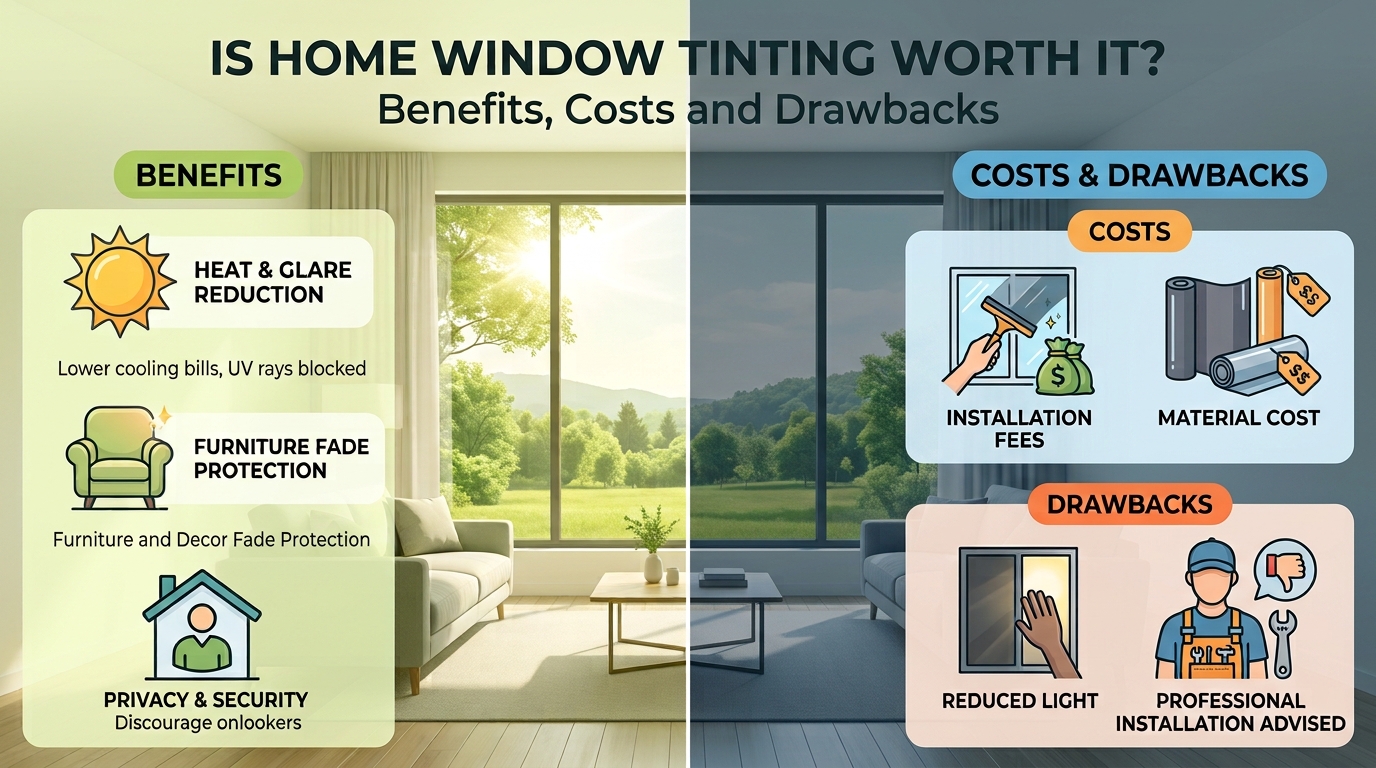
Home window tinting can make bright, sun-exposed rooms more comfortable, reduce glare, limit ultraviolet exposure, and provide added privacy. However, its value depends on the type of glass, window condition, film selection, orientation, and the problem you want to solve.
So, is home window tinting worth it? For many homeowners, it is a practical upgrade when excessive sunlight, glare, fading, or daytime privacy is the main concern. It is less suitable when windows already have failed seals, damaged glass, or performance issues that require repair or replacement.
What Is Residential Window Tinting?
Residential window tinting involves applying a thin film to an existing glass surface. Unlike automotive tint, residential window film is engineered for architectural glass and may be used for solar control, glare reduction, privacy, decoration, or added glass retention.
Common options include:
- Solar-control film to manage heat and glare
- Low-reflectivity or neutral film for a less noticeable appearance
- Reflective film for stronger daytime privacy
- Decorative or frosted film for bathrooms and private rooms
- Safety and security film designed to help hold broken glass fragments together
- Energy-efficient window film intended to improve specific aspects of glazing performance
Window film does not repair cracks, failed seals, fogging between panes, damaged frames, or water intrusion. Those conditions should be professionally assessed before film is considered.
Is Home Window Tinting Worth It for Portland Properties?
Home window tinting is often worthwhile when it addresses a clearly identified problem. A west-facing living room that becomes uncomfortable in the afternoon, for example, may benefit more than a shaded north-facing room.
In the Greater Portland area, window film may be useful for properties with:
- Large windows exposed to direct afternoon sun
- Rooms affected by screen glare
- Furniture, flooring, artwork, or merchandise exposed to sunlight
- Street-facing windows that need more daytime privacy
- Interior glass that needs a decorative or obscured appearance
- Existing windows that remain serviceable but need improved solar control
Portland’s weather does not eliminate the need for solar control. Individual rooms can still overheat when large areas of glass receive direct sunlight. However, film should be selected for the property’s actual exposure rather than applied uniformly to every window.
Seven Important Window Tinting Benefits
1. Better control of solar heat
Solar-control film can reduce the amount of solar heat passing through glass. This may make sun-exposed rooms more comfortable and reduce temperature differences between rooms.
The U.S. Department of Energy identifies window film as an option for blocking solar heat gain while controlling glare and ultraviolet exposure. It also notes that film is particularly useful in climates with long cooling seasons, so expected energy benefits should be evaluated according to the building and local conditions.
2. Reduced glare
Glare can make it difficult to watch television, use a computer, or work near a bright window. Properly selected film can soften intense sunlight without requiring curtains or blinds to remain closed throughout the day.
A darker film is not always necessary. Some neutral and lower-reflectivity products provide solar control while preserving more natural light.
3. Protection against ultraviolet exposure
Residential window film can limit ultraviolet exposure through glass. This may help slow one contributor to fading, although fading can also result from visible light, heat, humidity, material quality, and age.
Window film should therefore be viewed as one part of an interior-protection strategy, not a guarantee that furnishings will never fade.
4. Greater daytime privacy
Reflective and darker films can make it more difficult to see inside during daylight when the exterior is brighter than the interior. Frosted and decorative films can provide more consistent visual screening for bathrooms, entry doors, sidelights, and office partitions.
Reflective film does not provide dependable nighttime privacy. When interior lights are on and it is dark outside, occupants may be visible from outdoors. Curtains, shades, or another permanent privacy treatment may still be needed.
5. Improved appearance
Window film can update mismatched or visually dated glass without replacing an entire window. Neutral, reflective, patterned, and frosted finishes allow property owners to choose an appearance suited to the building.
Film appearance should be reviewed from both inside and outside. A product that looks subtle indoors may create a noticeably reflective exterior.
6. Less disruption than window replacement
When the glass and window units remain in good condition, installing film is generally less disruptive than replacing the full window assembly. This makes it useful when the goal is solar control or privacy rather than correcting structural or performance failures.
7. Specialized glass-retention options
Safety and security films are thicker than typical solar films and are designed to help retain glass fragments after breakage. They should not be described as making a window unbreakable, and their performance depends on the complete system, including the film, glass, frame, attachment method, and installation.
Pros and Cons of Home Window Tinting
|
Potential advantages |
Potential drawbacks |
|
Reduces glare in bright rooms |
May reduce visible light |
|
Helps control solar heat gain |
Some films change the exterior appearance |
|
Limits ultraviolet exposure |
Reflective privacy is generally weaker at night |
|
Adds privacy or decorative screening |
Incorrect film selection may increase thermal stress |
|
Can improve comfort near sun-facing glass |
Film can scratch, bubble, peel, or discolor as it ages |
|
Usually requires less disruption than window replacement |
May affect an existing window warranty |
|
Can be applied selectively |
Cannot repair damaged or failed windows |
Understanding these pros and cons of home window tinting helps prevent unrealistic expectations. The best results come from matching the product to the glass, room, exposure, and desired outcome.
What Are the Disadvantages of Window Tinting?
Reduced daylight and altered views
Dark or highly reflective film may make a room feel dimmer, especially during Portland’s overcast months. Some products can also change color perception or create an interior reflection after dark.
Ask to see a physical sample on the actual window before approving a full installation.
Nighttime privacy limitations
Reflective residential window film relies partly on differences in indoor and outdoor light. It may offer daytime privacy but reverse its effect at night when the room is brighter than the exterior.
Frosted film offers more consistent screening, but it also obscures the view in both directions.
Glass compatibility concerns
Film absorbs or reflects solar energy differently depending on its construction. Glass type, pane thickness, coatings, edge condition, shading patterns, and sun exposure can all affect suitability.
The International Window Film Association warns that very dark, highly absorptive films may not be appropriate for certain glass types and exposures because of thermal-stress breakage risk. A qualified installer should identify the glass and confirm compatible products before installation.
Possible warranty restrictions
Applying aftermarket film may affect a window or insulated-glass warranty. Homeowners should review the window manufacturer’s terms and the film manufacturer’s coverage before work begins.
Maintenance and eventual replacement
Film is a surface-applied product. It can be damaged by abrasive cleaners, hard tools, or improper maintenance, and it may eventually need replacement. Longevity varies by product, exposure, glass type, installation, and care.
Home Window Tinting Cost
Current national consumer pricing guidance places professionally installed home window tinting at approximately $7 to $15 per square foot on average. Actual house window tinting cost may fall outside that range depending on the product and project conditions.
This national range is not a guaranteed Portland estimate. Contractors may also use minimum service charges or quote by window, project, or total glass area.
What affects the final price?
- Film type
Basic solar film, decorative film, premium solar-control products, and thicker safety films have different material and installation requirements. - Total glass area
Larger projects generally cost more overall, although per-square-foot pricing may change with volume. - Window size and shape
Oversized panes, divided windows, curved glass, skylights, and custom shapes may require additional labor. - Accessibility
High, difficult-to-reach, or obstructed windows may require special access planning. - Existing film or residue
Removing old film and adhesive can increase labor costs. - Glass condition and construction
The contractor may need to inspect the glazing before recommending a compatible product. - Preparation requirements
Heavy contamination, paint, sealant, or surface damage can affect preparation and installation.
A reliable estimate should identify the film, covered glass areas, preparation, labor, and applicable product or installation warranty.
How to Choose the Right Residential Window Film
Start by defining the main problem rather than selecting a film based only on appearance.
- For overheated rooms: compare solar heat gain performance.
- For glare: review visible light transmission and glare reduction.
- For a natural look: consider neutral or minimally reflective options.
- For daytime privacy: evaluate reflective film while planning separate nighttime coverage.
- For constant visual screening: consider frosted or decorative film.
- For glass retention: ask about an engineered safety-film system.
- For energy performance: compare independently verified ratings when available.
The National Fenestration Rating Council independently tests and certifies window films for energy performance. Its ratings can help consumers compare products using consistent measurements rather than relying only on marketing language.
Window Tinting, Glass Repair, or Window Replacement?
Choose window film when the existing glass is serviceable and the goal is better solar control, glare reduction, privacy, or appearance.
Request a glass assessment when you notice:
- Cracks, chips, or impact damage
- Fogging or moisture between panes
- Failed insulated-glass seals
- Water leakage around the window
- Loose or damaged framing
- Significant drafts
- Glass that may not meet the project’s safety requirements
Film cannot correct these problems. Depending on the condition, targeted glass replacement may be more appropriate than replacing the entire frame, while severe frame or installation issues may require a broader window solution.
Frequently Asked Questions
1. Is home window tinting worth it?
Yes, when properly selected film solves a specific issue such as glare, solar heat, ultraviolet exposure, or daytime privacy.
2. Does residential window tinting make rooms dark?
It can, but lighter and neutral films are available for homeowners who want to preserve natural light.
3. Does window film provide privacy at night?
Reflective film usually does not provide dependable nighttime privacy when interior lights are brighter than the outdoors.
4. Can window tint reduce energy bills?
It may reduce solar heat gain, but actual savings depend on the film, glazing, exposure, building, weather, and HVAC use.
5. Can film be installed on double-pane windows?
Some films can, but compatibility must be confirmed for the specific insulated-glass unit and its warranty.
6. Can window film fix foggy glass?
No; fogging between panes usually indicates an insulated-glass seal problem that film cannot repair.
7. Is darker window film always more effective?
No; performance depends on the film’s construction and ratings, not color alone.
8. How should tinted windows be cleaned?
Follow the film manufacturer’s instructions and avoid abrasive cleaners, blades, or rough tools.
9. Should every window receive the same film?
Not necessarily; film can be selected according to each window’s orientation, exposure, room use, and privacy needs.
Conclusion
Home window tinting can be a worthwhile improvement for controlling glare, managing solar heat, limiting ultraviolet exposure, and adding privacy. Its success depends on choosing a film compatible with the existing glass and realistic expectations about daylight, appearance, nighttime privacy, energy performance, and maintenance.
For properties in Portland, Oregon, The Glass People can help assess existing glass and recommend an appropriate next step. Homeowners, business owners, property managers, contractors, and developers who need professional residential, commercial, or custom glass repair, replacement, or installation services can contact The Glass People for expert guidance and a project estimate.
General Information Disclaimer
This article is provided for general informational purposes only. Glass requirements, product suitability, project costs, installation methods, and applicable building or safety codes may vary by property and location.
References Used
- U.S. Department of Energy, Energy Saver — “Energy Efficient Window Coverings.”
- National Fenestration Rating Council — “Window Films” and “Residential Product Certification.”
- International Window Film Association — “Flat Glass Solar Control Education Manual.”
- Angi — “How Much Does Home Window Tinting Cost? 2026 Data.”