Low Iron Glass vs Clear Glass: Which Is Better for Retail Displays?
When comparing low iron glass vs clear glass, low-iron glass generally offers the better view when accurate product color and minimal green tint matter. Standard clear glass remains a practical, lower-cost option when that visual difference is less important.
For Portland retailers, the right choice depends on the merchandise, display lighting, glass thickness, and overall budget. A jewelry case, a boutique’s glass shelving, and a large storefront window have different requirements. Understanding those differences helps you invest where customers will actually notice the improvement.
What Is the Difference Between These Glass Types?
Standard clear glass
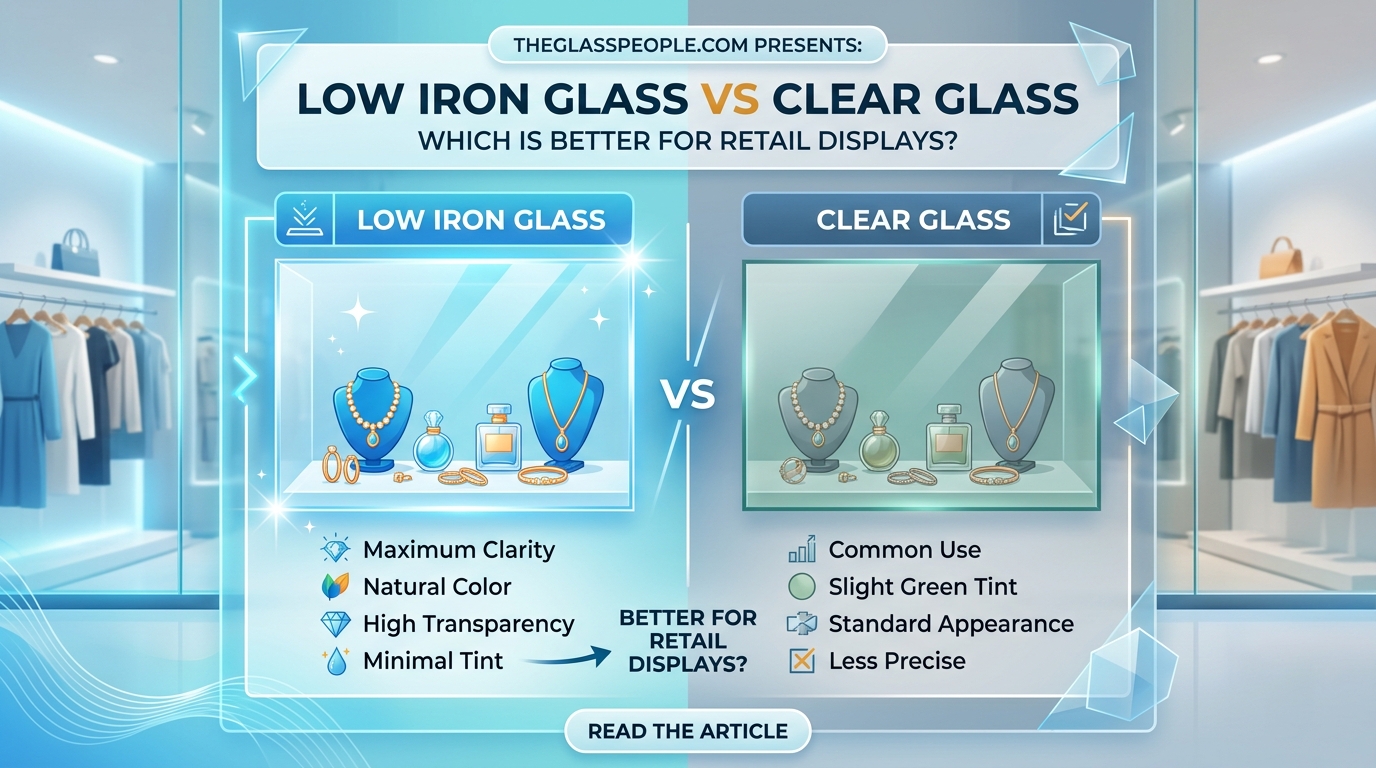
Standard clear glass is transparent, but its iron content gives it a subtle green cast. The clear glass green tint becomes more noticeable through thicker panels and along exposed edges. Against white backgrounds or pale merchandise, that color can be easier to see.
Low-iron glass
Low-iron glass uses raw materials with less iron, reducing the green cast and producing a more neutral appearance. Often called ultra clear glass, it suits displays where shoppers need to see products with minimal color interference.
“Ultra clear” describes appearance; it does not specify thickness, safety treatment, or a particular manufacturer. Ask for the actual product specification rather than relying on that label alone.
Low Iron Glass vs Clear Glass: At-a-Glance Comparison
|
Consideration |
Standard clear glass |
Low-iron glass |
|
Color appearance |
Subtle green cast |
More neutral color |
|
Exposed edges |
More noticeable green tint |
Reduced green tint; some products have a pale blue edge |
|
Thicker panels |
Green cast becomes more apparent |
Better color neutrality at greater thickness |
|
Visible light transmission |
Depends on thickness and construction |
Generally higher for comparable uncoated glass |
|
Relative material cost |
Typically lower |
Typically higher |
|
Safety and security |
Depend on processing and assembly |
Depend on processing and assembly |
These distinctions concern the base glass; safety properties depend on the specified finished product.
Compare equivalent thicknesses and constructions. A thin clear panel and a thick laminated low-iron panel are not a useful like-for-like comparison.
Low-Iron Glass Benefits for Retail Displays
More accurate product color
Low iron glass clarity helps preserve the appearance of merchandise viewed through the glass. This can matter when customers compare gemstone colors, cosmetics, textiles, artwork, or products displayed against white backgrounds. Pilkington identifies truer color rendering as an important benefit of low-iron display glass.
For example, consider a case containing white ceramic pieces and pale pink accessories. Reduced green tint can help shoppers see those shades more faithfully. That visual benefit does not guarantee increased sales.
Less distracting exposed edges
Glass shelves and frameless cases show their edges as well as their faces. Low iron display glass reduces the strong green edge associated with standard clear glass, supporting a cleaner appearance.
The edge is not necessarily colorless: some low-iron products have a pale blue edge. Review a physical sample at the proposed thickness before specifying a complete display.
Higher light transmission, especially in thicker glass
Low iron glass light transmission generally exceeds that of comparable standard clear glass, but the difference depends on thickness.
Vitro’s published comparison lists 1/8-inch clear glass at 90% visible light transmission and Starphire low-iron glass at 91%. At 3/4 inch, the listed values are 83% and 90%, respectively. These are product-specific examples, not universal ratings for every finished display.
The practical benefit is often color neutrality rather than a dramatic brightness change in a thin panel.
When Standard Clear Glass Makes Sense
Standard clear glass can be a sensible choice for utility shelving, framed displays with concealed edges, or merchandise whose presentation does not depend on subtle color differences.
It also deserves consideration when the budget must cover lighting, hardware, security, and installation. Upgrading every pane may offer less value than improving the most important viewing surfaces.
A useful way to judge low iron glass vs clear glass is to compare both samples beside your actual merchandise. If the difference is barely visible under the store’s lighting, standard clear glass may meet your needs.
Clarity Is Only One Part of the Specification
Reflections and glare
Low-iron glass still reflects light. Reducing its green tint does not make it anti-reflective.
If customers mainly see ceiling lights, street reflections, or their own faces in a display, ask about a compatible anti-reflective product and review the lighting layout. Guardian identifies anti-reflective coatings as an additional feature that can be combined with low-iron glass.
Safety, thickness, and security
Neither “clear” nor “low-iron” automatically means safety glass. Suitable low-iron products can be tempered or laminated, but the required construction must be specified.
Tempered glass breaks into smaller fragments, while laminated glass uses an interlayer that generally holds broken pieces together. The appropriate choice depends on the location, likely impacts, and applicable requirements.
A professional should determine shelf thickness and support spacing from the panel dimensions, loading, hardware, and intended use. For valuable merchandise, ask separately about security glazing and the case’s locks and framing; low iron content alone does not provide theft resistance.
Scratch resistance and merchandise protection
Low-iron glass is not inherently scratch-proof. Vitro states that its Starphire glass has the same surface hardness and scratch resistance as standard clear glass.
Likewise, greater clarity does not establish UV protection for light-sensitive merchandise. Ask for verified UV-performance information and any suitable protective interlayer. Laminated glass can incorporate UV-protection properties, depending on its construction.
For exterior storefronts, review thermal performance and solar control separately. Low-iron glass can be combined with coatings and insulating constructions, but clarity alone does not establish energy efficiency.
Low-Iron Glass Cost: How to Compare Quotes
Low iron glass cost is typically higher than the cost of comparable standard clear glass. Higher-purity raw materials and production requirements contribute to that premium. However, there is no single reliable price for every retail display.
Ask your glass professional to account for:
- Panel dimensions, quantity, and required thickness.
- Tempering, lamination, coatings, and edge finishing.
- Cutouts, hardware, supports, and existing frame condition.
- Site access, removal, installation, and project scheduling.
For a fair low iron glass vs clear glass quote comparison, keep these specifications consistent and request the upgrade price as a separate line item.
If the budget is limited, consider low-iron glass for the main viewing panels or the most visible shelves. Review the entire proposed combination first, because adjoining panels may show different color casts.
For a replacement project, confirm how the new panel will match neighboring glass. Request a project estimate based on professional measurements and the actual installation conditions.
How to Choose the Best Glass for Retail Displays
- Identify what shoppers need to see. Prioritize color accuracy for jewelry, cosmetics, art, and carefully styled merchandise; consider standard clear glass for less visually demanding uses.
- Review samples under actual lighting. Look through the face and along the edge, with representative products behind the glass. Avoid choosing from online photos alone.
- Confirm the complete construction. Ask about thickness, supports, safety treatment, coatings, and security requirements before approving the material.
- Check replacement and scheduling needs. Confirm fabrication timing, installation access, and how future replacement panels will be specified.
For Greater Portland stores, evaluate exterior-facing displays in daylight and after dark. Interior lighting and outdoor reflections can change what customers see from the sidewalk. Arrange a larger mockup when a small sample cannot adequately represent a prominent storefront or display.
Cleaning, Maintenance, and Replacement
Use clean, soft cloths and a manufacturer-approved, nonabrasive cleaner. Coated glass may need product-specific care: Pilkington’s OptiView cleaning guidance cautions against abrasives, razor blades, and metal contact on its anti-reflective surface.
Ask the installer for written care instructions and keep the product specification for future replacements. Low-iron glass still needs routine cleaning to remove fingerprints and deposits.
If a display panel cracks or develops edge damage, restrict access and arrange professional assessment. Staff should not remove or reposition damaged, heavy glass. Replacing a pane also provides an opportunity to check its supports, hardware, and surrounding frame.
Frequently Asked Questions
1. Is low iron glass worth it for retail displays?
It often is when accurate colors, exposed edges, or thicker viewing panels make the visual improvement noticeable.
2. Why does standard clear glass look green?
Its iron content creates a green cast that becomes more apparent at edges and through thicker glass.
3. Is ultra clear glass the same as low-iron glass?
The term commonly refers to low-iron glass, but confirm the manufacturer and product specification.
4. Does low-iron glass eliminate reflections?
No; reflection control requires an appropriate anti-reflective product and attention to lighting.
5. Is low-iron glass stronger than clear glass?
Low iron content does not establish greater strength; thickness, processing, and support determine suitability.
6. Can low-iron glass be tempered or laminated?
Yes, suitable low-iron products can be tempered or laminated for specified applications.
7. Does low-iron glass cost more?
It typically costs more than comparable clear glass, with the installed difference depending on the project.
8. Can I replace one clear panel with low-iron glass?
Possibly, but a professional should verify fit, safety requirements, and the appearance beside existing panels.
9. Is low-iron glass automatically UV-protective?
No; confirm UV performance separately when displaying light-sensitive merchandise.
Conclusion
Low-iron glass is generally the stronger choice for retail displays that depend on faithful colors, discreet edges, and clear views through thicker panels. Standard clear glass remains useful when the difference is minor or other improvements deserve priority. Compare samples, review the complete specification, and base the decision on an installation estimate.
For help evaluating a retail display in Portland, Oregon, consider contacting The Glass People. Readers who need professional residential, commercial, or custom glass repair, replacement, or installation services can contact The Glass People for expert guidance and a project estimate. Discuss your merchandise, existing glass, and installation requirements to identify suitable options.
General Information Disclaimer:
This article is provided for general informational purposes only. Glass requirements, product suitability, project costs, installation methods, and applicable building or safety codes may vary by property and location.
References Used
- Vitro Architectural Glass — “Low-Iron Glass”: composition, color differences, and thickness-specific light transmission.
- Pilkington — “Pilkington Optiwhite”: color neutrality, visible edges, and processing options.
- Pilkington — “Museum and Display Cases”: color rendering in display applications.
- Guardian Glass — “Low-iron glass: Clear and neutral glazing”: edge appearance, coatings, and storefront applications.
- Vitro Architectural Glass — “Heavy Starphire Glass”: surface hardness and scratch resistance.
- Guardian Glass — “Safety glass”: tempered and laminated breakage behavior.
- Guardian Glass — “Laminated glass”: interlayers and UV-protection options.
- Everest — “Low-Iron Glass Explained”: general reasons for the material cost premium.
- Pilkington North America — Technical Bulletin ATS-182, “Hand Washing Pilkington OptiView Anti-Reflective Glass”: cleaning precautions.