How to Fix a Broken Window Without Replacing It? Practical Repair Options
A damaged window does not always require replacing the entire window assembly. Small chips, minor surface cracks, failed seals, and damaged glazing materials may have repair options that preserve the existing frame. However, anyone researching how to fix broken window glass should understand that shattered, unstable, or safety-rated glass generally cannot be restored to its original strength.
The right solution depends on the damage, glass type, location, and condition of the frame. Some methods provide limited stabilization, while others address air or water leaks without repairing the glass itself. A professional assessment is the safest way to distinguish a repairable defect from glass that requires replacement.
Can Broken Window Glass Actually Be Repaired?
The answer depends on what “broken” means. A small surface chip may be repairable under limited circumstances, while a full-thickness crack or shattered pane usually requires glass replacement.
Repair may be possible when:
- The damage is a small, shallow surface chip.
- A hairline crack is short, stable, and away from the glass edge.
- The glass remains firmly secured inside the frame.
- The problem involves loose glazing, failed caulk, or damaged weatherstripping rather than broken glass.
- A professional determines that resin or glass repair epoxy is appropriate.
Replacement is usually necessary when:
- The pane has shattered or contains loose fragments.
- A crack reaches the edge of the glass.
- The damage is spreading or passes completely through the pane.
- Tempered glass has broken.
- One pane of an insulated glass unit is cracked.
- The window is in a safety-sensitive or high-impact location.
- The frame no longer holds the glass securely.
Even when the glass must be replaced, the frame, sash, trim, and surrounding wall may remain in place. This glass-only approach can be substantially less disruptive than replacing the complete window.
How to Fix Broken Window Glass: Start With a Safe Assessment
Before deciding how to fix broken window glass, keep people and pets away from the area and avoid touching, pressing, or operating the damaged pane. Do not attempt to remove loose fragments, cut replacement glass, or lift a large panel without professional equipment and experience.
Evaluate the window from a safe distance:
- Identify the damage
Determine whether you are dealing with a chip, hairline crack, long crack, impact break, missing section, fogging, or a frame-related leak.
- Check the pane’s stability
A pane that moves, bows, rattles, or contains loose pieces needs immediate professional attention. Avoid opening or closing the window because movement could cause further breakage.
- Identify the glass system
Single-pane glass, insulated double-pane units, laminated glass, and tempered glass respond differently to damage. A repair method suitable for a small chip in ordinary annealed glass may be inappropriate for safety or insulated glazing.
- Inspect the frame
Look for rot, corrosion, failed seals, bent components, or separated glazing materials. Repairing a crack will not solve an underlying frame problem that continues to place stress on the glass.
- Consider the location
Windows in doors, bathrooms, stair areas, storefronts, and other locations exposed to human impact may have specific safety-glazing requirements. Federal architectural glazing standards cover several impact-prone products, including doors, shower enclosures, and sliding glass doors. [1]
Practical Repair Options Without Replacing the Entire Window
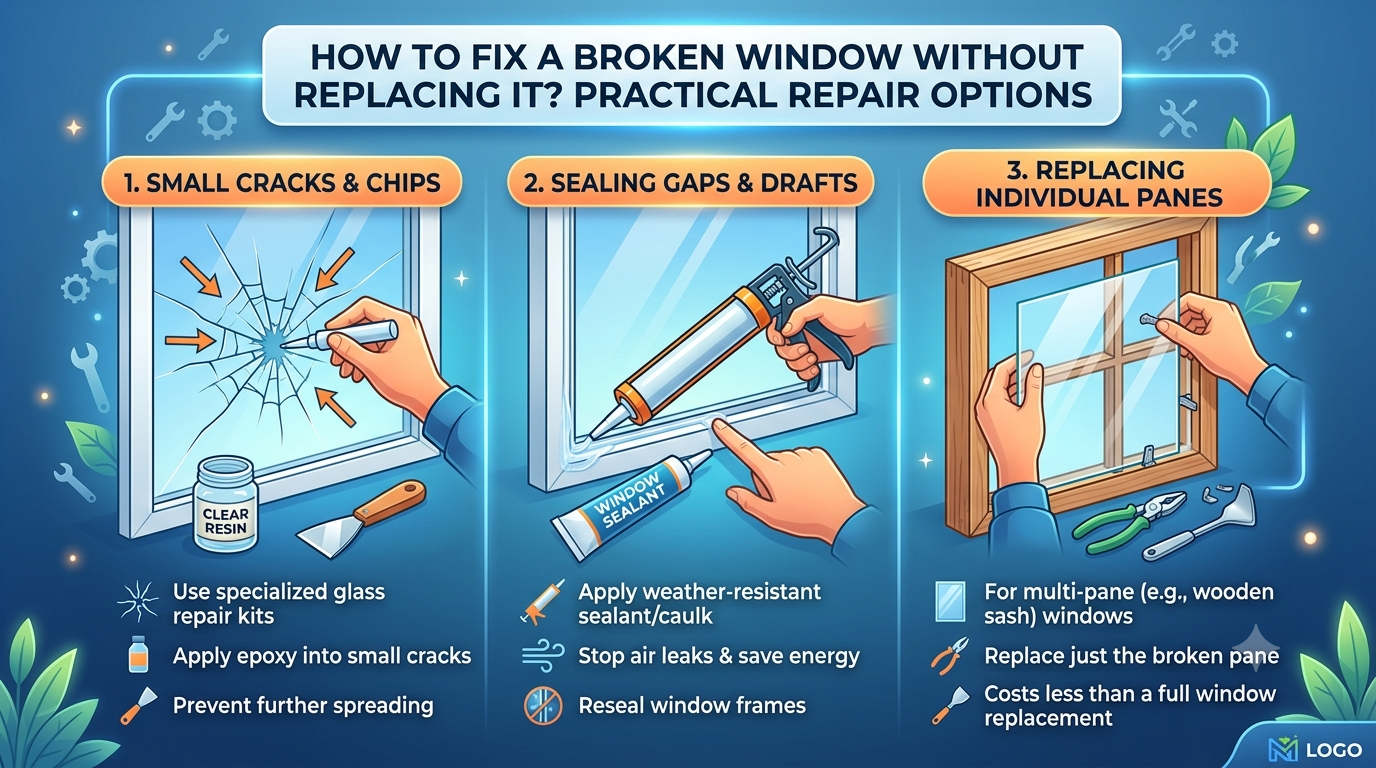
1. Professional Resin or Epoxy Repair
When people ask how to fix cracked window without replacing it, resin repair is often the option they have in mind. A qualified technician may use a clear repair resin or glass repair epoxy on certain small chips and stable surface cracks.
This method may:
- Fill a shallow damaged area.
- Reduce the visibility of a minor defect.
- Limit contamination by dirt or moisture.
- Help stabilize suitable surface damage.
Epoxy does not recreate the pane’s original manufactured strength or restore a safety rating. It may also remain slightly visible after curing. It should not be treated as a permanent structural solution for large, edge-reaching, full-thickness, or actively spreading cracks.
Avoid applying pressure or drilling into architectural glass to stop a crack. The wrong material or technique can worsen the damage, interfere with a later professional repair, or cause the pane to fail.
2. Temporary Crack Containment
A specialized clear film or carefully applied tape may help contain a stable cracked pane until professional service is available. This is a temporary fix for broken window damage—not a structural repair.
Temporary containment may reduce movement and help hold fragments together, but it will not restore security, weather resistance, insulation, or impact performance. Never press hard against the pane while applying a temporary material. If the glass moves or contains loose pieces, keep the area isolated and contact a glass professional instead.
3. Professional Board-Up or Weather Protection
When part of the pane is missing, immediate weather protection may be necessary. A professional board-up or temporary weather panel can help secure the opening against rain, wind, unauthorized entry, and accidental contact.
This can be particularly important during Portland’s wet months, when an exposed opening may allow moisture into drywall, flooring, trim, or wall cavities. Do not attempt to pull remaining shards from the frame before covering the opening.
4. Reglazing and Perimeter Seal Repair
Sometimes the glass is intact, but the glazing putty, gasket, caulk, or seal around it has failed. Symptoms may include:
- Drafts around the pane.
- Water entering at the perimeter.
- Rattling glass.
- Loose or deteriorated glazing material.
- Small gaps between the glass and frame.
In these cases, window glass repair may involve renewing the perimeter materials rather than replacing the pane. This solution only works when the glass remains undamaged and the frame can support it correctly.
Caulk should not be applied over a crack as a substitute for repairing or replacing damaged glass. It may conceal the problem without restoring strength.
5. Replace Only the Glass or Insulated Unit
The most practical answer to how to fix broken window glass is often to retain the existing window and replace only the damaged glazing.
For a single-pane window, a glazier may replace the individual pane while preserving a serviceable frame. For a double-pane window, the complete insulated glass unit usually needs replacement because its panes, spacer, and perimeter seal function as one assembly.
Fogging or moisture between panes generally indicates an insulated glazing problem rather than a surface that can simply be cleaned. Industry homeowner guidance recommends watching for moisture or fogging between panes and damaged weatherstripping or caulk. [2]
Choosing the Right Repair Option
|
Window condition |
Practical response |
Is it permanent? |
|
Small, shallow surface chip |
Professional resin assessment |
Potentially, for suitable cosmetic damage |
|
Short, stable hairline crack |
Possible professional stabilization |
Often limited; replacement may still be recommended |
|
Long or spreading crack |
Glass-only replacement |
Yes, if the frame remains serviceable |
|
Shattered or missing glass |
Secure the area and arrange professional board-up and replacement |
Board-up is temporary |
|
Draft around intact glass |
Repair gasket, caulk, or glazing material |
Yes, if the frame and glass are sound |
|
Fog between double panes |
Replace the insulated glass unit |
Yes |
|
Bent, rotten, or badly corroded frame |
Repair or replace the affected window components |
Depends on frame condition |
When Should You Stop Repairing and Replace the Glass?
Cracked window repair is not appropriate when damage compromises the pane’s ability to remain securely in place. Arrange professional replacement if you notice:
- A crack extending from one edge to another.
- Multiple branching or web-shaped cracks.
- Loose, sharp, or falling fragments.
- Damage near a lock, hinge, or moving sash.
- Breakage in tempered or safety glazing.
- A cracked pane in a sealed double- or triple-pane unit.
- Water entering through the damaged glass.
- A large pane, elevated window, skylight, storefront, or hard-to-access installation.
- Damage caused by a distorted or failing frame.
Do not continue using an operable window with unstable glass. Vibration from opening, closing, wind, or nearby construction can make existing damage worse.
What Affects the Cost of Broken Window Repair?
A reliable estimate requires inspection because several factors influence the work:
- Type, thickness, size, and shape of the glass.
- Single-pane or insulated construction.
- Tempered, laminated, tinted, coated, patterned, or custom glass.
- Crack location and severity.
- Accessibility and installation height.
- Condition of the sash, seals, and frame.
- Need for temporary board-up.
- Residential, commercial, or custom fabrication requirements.
- Applicable safety and energy-efficiency requirements.
A glass-only replacement may preserve a good frame, but it is not automatically suitable for every window. If the frame is deteriorated or no longer square, replacing the glass alone may not correct the cause of the failure.
Portland-Area Repair Considerations
Oregon’s statewide interpretation for existing residential glazing states that replacement glazing must meet current safety-glazing and energy-efficiency provisions, although project-specific exceptions may apply. [3]
A local professional can evaluate the window’s location, glass type, building use, and installation conditions before recommending a product.
Older Portland-area properties also require additional care. Work around painted windows in pre-1978 buildings can disturb lead-based paint and create hazardous dust. The EPA recommends determining whether lead paint is present and using lead-safe practices or qualified professionals. [4]
How to Reduce the Risk of Future Window Damage
- Repair sticking or misaligned sashes instead of forcing them.
- Replace worn weatherstripping and failed perimeter seals.
- Keep hard objects and landscaping away from vulnerable glass.
- Avoid slamming windows and doors.
- Have frame movement, corrosion, or wood deterioration addressed promptly.
- Ask a professional whether safety, laminated, or other specialized glazing is appropriate for the location.
- Inspect repaired areas periodically for spreading cracks, moisture, or movement.
Frequently Asked Questions
1. Can glass repair epoxy permanently fix a cracked window?
It may stabilize certain minor surface defects, but it does not restore the original strength of severely cracked or safety-rated glass.
2. Will tape stop a window crack from spreading?
Tape may provide temporary containment, but it cannot reliably stop crack growth or restore structural integrity.
3. Can a double-pane window crack be repaired without replacement?
The frame may remain, but a cracked insulated glass unit generally needs to be replaced as a complete sealed unit.
4. Can fog between window panes be repaired?
Surface cleaning will not remove internal fogging; the sealed insulated unit typically requires professional evaluation and replacement.
5. How long can a temporary window repair remain in place?
There is no guaranteed duration because weather, crack growth, vibration, and pane condition can cause sudden failure.
6. Must the entire window be replaced when one pane breaks?
Not always; a professional may be able to replace only the pane or insulated glass unit if the frame remains sound.
7. Is it safe to leave a cracked window overnight?
Only a professional assessment can confirm safety; isolate the area and seek prompt service if the glass is loose, spreading, or exposed.
8. Does window glass replacement require a Portland permit?
Requirements depend on the property and scope, so confirm current rules with the appropriate local authority or a qualified professional.
9. When should I call a professional glass company?
Call promptly for shattered, loose, edge-cracked, elevated, large, insulated, tempered, laminated, commercial, or safety-sensitive glass.
Conclusion
Minor chips, failed seals, and some stable surface cracks may have limited repair options, but shattered or structurally weakened glass cannot be safely restored with tape, caulk, or epoxy. Understanding how to fix broken window glass begins with identifying the glass type, securing the area, and determining whether stabilization, seal repair, glass-only replacement, or complete window work is appropriate.
Professional Glass Help in Portland, Oregon
Property owners who need professional residential, commercial, or custom glass repair, replacement, or installation services can contact The Glass People in Portland, Oregon. Their team can inspect the damage, explain suitable options, and provide expert guidance and a project estimate based on the property’s actual conditions.