Glass Table Tops: How to Choose the Right Thickness, Shape, and Edge
Glass table tops can protect a wood surface, replace a damaged dining tabletop, or create a clear work surface for an office. Choosing the right one starts with how the glass will be supported. A protective cover and a top that carries the table’s load have different requirements.
For homeowners and businesses throughout Greater Portland, the goal is a surface that fits the furniture, suits the room, and handles its intended use. Thickness, shape, edge finish, and glass treatment work together to achieve that result.
1. Start With How Your Glass Table Tops Will Be Supported
Protective Covers
A glass cover rests over an existing solid tabletop. It helps protect the furniture from everyday wear while keeping the underlying material visible. The glazier should check the supporting surface and specify suitable cushioning.
Glass as the Main Tabletop
When glass spans a frame, legs, or pedestal, it carries loads between supports. The distance between those supports matters, along with the panel’s dimensions and expected use.
The National Glass Association distinguishes decorative infill from load-bearing glass and emphasizes appropriate design and engineering for load-bearing applications.
2. Choose the Right Glass Table Top Thickness
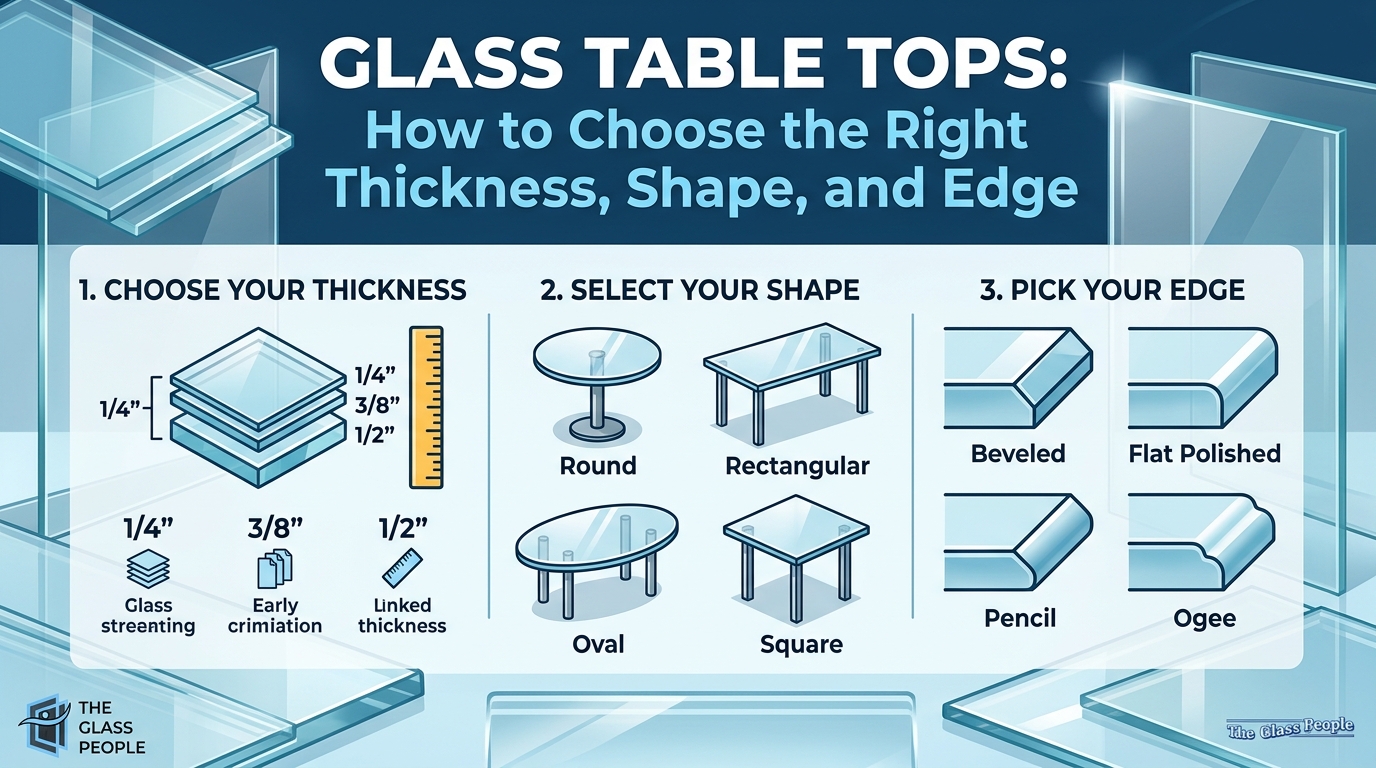
The best thickness for glass table tops depends on the complete table design. Use these common options to start a conversation with a glazier:
Nominal thickness |
Common application |
What needs confirmation |
|
3/16 inch |
Protective covers over solid furniture |
Surface support and intended use |
|
1/4 inch |
More substantial protective covers and some framed tops |
Panel dimensions and support arrangement |
|
3/8 inch |
Tops where glass forms the main surface |
Unsupported spans and expected loads |
|
1/2 inch |
Larger or heavier-use tabletop designs |
Base capacity, stability, and glass specification |
These categories reflect common fabricator guidance, not guaranteed load ratings.
Increasing glass table top thickness adds weight. A thicker replacement may exceed what an existing base can support, so confirm the furniture’s capacity before upgrading.
Two glass table tops with identical dimensions can need different specifications because their supports differ. For large spans, concentrated loads, or unusual bases, ask whether the design needs engineering review.
3. Select the Appropriate Safety Glass
Tempered Glass Table Tops
Tempered glass is stronger than ordinary annealed glass of the same thickness. When it breaks, it fragments into smaller pieces rather than the large shards associated with annealed glass. It can still cause injury and is not unbreakable.
All cutting, drilling, and edge finishing must happen before tempering. Confirm the finished design before fabrication because a tempered panel cannot be trimmed afterward.
Laminated Glass
Laminated glass uses an interlayer between glass layers to help hold fragments together after breakage. It may suit designs where fragment retention is important, but a broken laminated top still requires replacement assessment.
ASTM F2813 addresses safety-glass performance for unenclosed horizontal desk and table surfaces under 44 inches high. It is not a universal thickness chart or proof that a particular table meets local requirements. Ask the professional specifying your project to confirm the applicable standards.
4. Match Glass Table Top Shapes to the Room and Base
Round vs. Rectangular Glass Table Tops
Round tops eliminate projecting corners and can suit compact dining areas or conversation seating. Check chair clearance and whether the base supports the chosen diameter.
Rectangular tops often fit long dining rooms, desks, and conference spaces. Their corners need attention where people walk past; rounded corners can make those locations more comfortable.
Neither shape automatically makes a table stable. The base footprint, top size, and support arrangement remain essential.
Oval, Square, and Custom Shapes
Oval tops offer an elongated surface without square corners. Square tops can suit small seating groups, while custom shapes help match distinctive furniture.
For a replacement, start with the existing base and room layout. Changing the shape or enlarging the top may alter its balance and support requirements.
5. Compare Glass Table Top Edges
Edge finishing affects appearance and how the perimeter feels during everyday use. Common profiles include flat polished, pencil polished, and beveled edges.
Flat Polished Edge
A flat polished edge has a smooth, straight face with small chamfers at its upper and lower boundaries. It suits simple furniture designs and makes the glass thickness visible.
Pencil Polished Edge
A pencil polished edge has a rounded profile. It offers a softer perimeter for tables where hands and forearms frequently touch the edge.
A rounded edge profile does not round off a square tabletop corner; specify the corner shape separately.
Beveled Edge
A bevel creates a sloped border around the top surface. The benefits of a beveled glass table top include decorative detail and a border that catches light.
Choose it for appearance rather than assuming it adds strength. Confirm the bevel width, especially on a small top where the border occupies more of the surface.
For exposed furniture edges, request an appropriate finished profile. A basic seamed edge generally suits concealed edges rather than a prominent tabletop perimeter.
6. How to Measure Glass Table Tops
For an initial estimate, record accessible furniture dimensions without lifting or repositioning glass. A professional should verify the final fabrication measurements.
- Identify the application: a protective cover, recessed insert, or main tabletop.
- Record the shape and size: length and width for rectangles, diameter for circles, and overall length and width for ovals.
- Note the corners: specify the corner radius or request professional templating for irregular outlines.
- Describe the support: include frame dimensions, support locations, and whether the glass fits into a recess.
- Identify special features: note any required umbrella holes, cable openings, or hardware cutouts.
For rectangular furniture, checking both diagonals can reveal whether the frame is out of square. Have the glazier establish fitting clearance for recessed glass rather than subtracting an arbitrary amount.
Plan the Glass Table Top Overhang
Overhang is the portion extending beyond the supporting surface or base. A protective cover should generally follow the supporting furniture surface; a standalone top may have a designed overhang.
There is no universal safe allowance. Base stability, attachment, glass dimensions, and loads near the perimeter all matter. Confirm the overhang before ordering.
7. Understand What Affects a Custom Glass Quote
An estimate should account for more than the panel’s length and width. Ask for a written specification covering:
- Glass dimensions, thickness, and safety treatment.
- Shape, corner details, edge profile, and any holes.
- Measurement, fabrication, delivery, and professional placement.
- Removal and disposal requirements when replacing damaged glass.
Appearance choices also affect the specification. Standard clear glass has a green cast, while low-iron glass reduces that tint and can better preserve the appearance of light-colored furniture beneath it. Low-iron glass still needs the appropriate safety treatment.
For Portland homes, offices, or hospitality spaces, explain how frequently the table will be used and whether it will sit outdoors. Request a project-specific estimate after the base and access conditions have been reviewed.
8. Care for the Surface and Recognize Damage
Follow the fabricator’s cleaning instructions. Use a clean, soft cloth and an approved nonabrasive cleaner, and remove grit before wiping. Avoid abrasive pads and prevent cleaner from collecting against surrounding furniture or exposed laminated edges.
Use coasters and trivets, and keep heavy objects from striking the perimeter. Do not sit or stand on the table.
Stop using a top with cracks, edge chips, or unstable supports and arrange a professional assessment. Do not attempt to grind damaged edges or lift broken or heavy glass yourself.
Frequently Asked Questions
1. What Is the Best Thickness for a Glass Tabletop?
Choose thickness based on panel size, support spacing, intended loads, and the base’s capacity.
2. Is 1/4-Inch Glass Suitable for a Dining Table?
It may suit a supported cover, but a load-bearing dining top needs a design-specific assessment.
3. Does Thicker Glass Mean I Can Skip Tempering?
No; thickness does not make ordinary annealed glass a safety-glazing product.
4. Is Tempered Glass Scratch-Proof?
No; tempered glass can still scratch, so protect it from grit and abrasive cleaning materials.
5. Are Round Tables Better for Small Rooms?
They can improve movement around corners, but diameter, chair clearance, and base size determine the fit.
6. Does a Beveled Edge Make Glass Stronger?
A bevel adds decorative detail; it does not establish the tabletop’s strength or load capacity.
7. How Much Should a Glass Top Overhang Its Base?
Have the overhang specified for the particular base, panel, attachment, and intended use.
8. Can a Tempered Top Be Resized Later?
No; its dimensions, holes, and edge work must be finalized before tempering.
9. Can I Keep Using a Tabletop With an Edge Chip?
Stop using it and have a glass professional assess the damage and replacement needs.
Conclusion
Choose the thickness around the support design, the shape around the furniture and room, and the edge around appearance and everyday contact. Accurate measurements and an appropriate safety-glass specification help turn those choices into a well-fitted surface. Before ordering, have a professional review the base, intended use, and finished dimensions.
For projects in Portland, Oregon, consider contacting The Glass People for expert guidance and a project estimate. Readers who need professional residential, commercial, or custom glass repair, replacement, or installation services can discuss their requirements and suitable options with the team.
General Information Disclaimer:
This article is provided for general informational purposes only. Glass requirements, product suitability, project costs, installation methods, and applicable building or safety codes may vary by property and location.
References Used
- National Glass Association — Laminated Glass Use in Furniture, FB37-12 (2019).
- One Day Glass — What Glass Thickness Do I Need for My Glass Table Top?
- ASTM International — ASTM F2813-18(2023), Standard Specification for Glass Used as a Horizontal Surface in Desks and Tables; published scope and abstract.
- Pilkington — Pilkington Toughened Glass.
- One Day Glass — Specialty Edge Finishing and Tempered Glass Table Top.
- SW Glass — How to Measure for a Glass Table Top.
- Pilkington — Pilkington Optiwhite product information.
- National Glass Association — Proper Procedures for Cleaning Architectural Glass Products, FB01-00 (2020).