Custom-Cut Mirrors: Types, Sizes, Edge Options, and Benefits
Custom-cut mirrors offer a practical way to fit reflective glass around a room’s exact dimensions, fixtures, and design. Instead of adapting a standard product to an awkward wall or vanity, you can specify the shape, size, thickness, edge finish, and mounting approach that suit the space.
For homeowners and commercial project teams in Greater Portland, this flexibility is useful in bathrooms, bedrooms, entryways, fitness rooms, retail interiors, offices, and multifamily properties. The best results come from matching the specification and installation method to the application.
What Are Custom-Cut Mirrors?
A custom mirror starts as flat mirror glass that a fabricator cuts and finishes for a particular opening or design. Standard silvered flat glass mirror uses a glass substrate with reflective metallic layers and a protective backing. ASTM C1503-24 addresses quality requirements for silvered annealed clear and tinted flat glass mirror up to 1/4 inch thick, but it does not cover safety-glazing requirements or finished edgework.[1]
That distinction matters. “Custom” can describe far more than the outside dimensions. The order may include a nonrectangular shape, polished or beveled edges, drilled holes, notches, corner treatments, safety backing, or a particular mounting system. Availability depends on the fabricator, mirror product, dimensions, and intended use.
Types of Custom Mirrors
Bathroom and Vanity Mirrors
Made-to-measure mirrors can align with a single or double vanity, fit between walls, stop below lighting, or coordinate with tile and cabinetry. Custom bathroom mirror sizes are especially useful when a stock mirror would leave uneven gaps or conflict with sconces, outlets, or backsplashes.
Full-Length and Dressing Mirrors
These mirrors may be wall-mounted, framed, recessed into millwork, or incorporated into a dressing area. For larger pieces, review thickness, support, access, and mounting before fabrication.
Decorative and Statement Mirrors
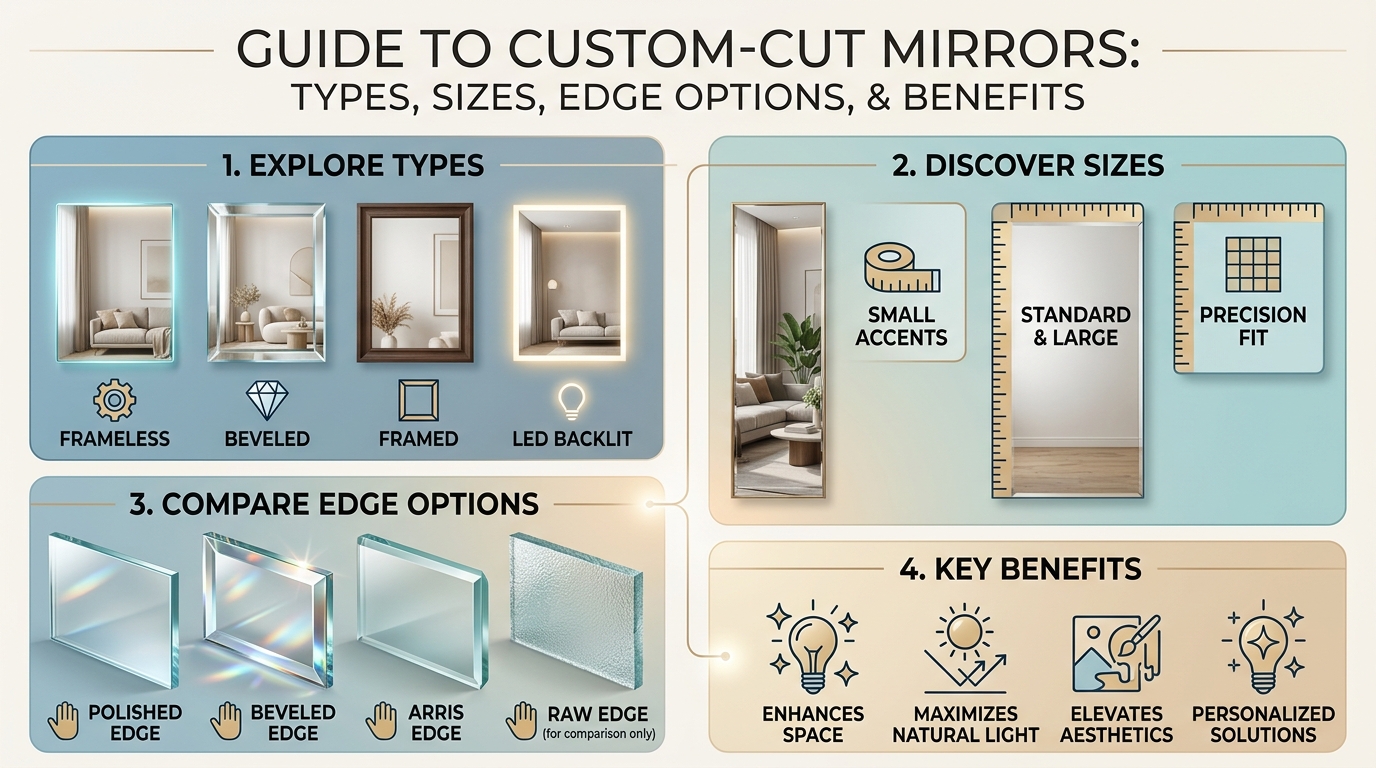
Round, oval, arched, geometric, and asymmetrical shapes can turn a mirror into a design feature. A frameless polished edge creates a clean look, while a bevel gives the perimeter more visual depth. Specialty mirror colors or antiqued finishes may also be available, depending on the supplier.
Wall, Fitness, and Studio Mirrors
Multiple mirror panels can cover long walls in home gyms, dance studios, salons, and fitness facilities. Panel sizing, seams, wall flatness, reflected sightlines, and protection from accidental impact all affect the finished appearance and specification.
Commercial Mirrors
Commercial mirrors serve restrooms, fitting rooms, lobbies, retail displays, and multifamily common areas. Coordination with millwork, lighting, accessibility layouts, and schedules makes field verification important.
Choosing the Right Size and Shape
Mirrors cut to size do not follow one universal size chart. A fabricator’s sheet dimensions, machinery, transportation limits, installation access, and the mirror’s thickness can all limit the finished piece. A very large design may work better as carefully planned panels rather than one oversized mirror.
Start with the visual goal. A vanity mirror might align with the cabinet, lighting, or wall opening, while a full-wall mirror may need balanced seams. Then account for practical conditions:
- Walls, ceilings, countertops, and tile edges may not be perfectly level, plumb, or square.
- Exposed edges require a finished edge; edges concealed by a frame or channel may need a different treatment.
- Outlets, switches, faucets, trim, and light fixtures can affect the perimeter or require precision fabrication.
- Mirror thickness should be selected for the dimensions, support conditions, mounting system, and application—not appearance alone.
- Elevators, stairways, door openings, and turning space can determine whether a large mirror can reach the installation area.
For mirror glass cut to size, final dimensions should come from verified field conditions, not only plans or nominal cabinet sizes.
How to Measure for a Custom Mirror
Preliminary measurements help with design and budgeting, but a professional should verify the opening before the mirror is fabricated.
- Define the intended perimeter. Decide whether the mirror will fit between two surfaces, overlap a backsplash, align with a vanity, or sit within a frame.
- Measure in several places. Check width at the top, middle, and bottom, then height at the left, center, and right to reveal out-of-square conditions.
- Record obstructions. Note outlets, switches, sconces, trim, faucets, shelves, and other items near the proposed glass.
- Check the wall. Bows, high spots, damaged drywall, uncured finishes, or uneven tile can affect fit and reflection quality.
- Leave fabrication allowances to the installer. Do not assume a universal deduction around the glass; the required clearance depends on the edge, mounting method, and surrounding materials.
- Approve a final drawing. Confirm dimensions, orientation, edge finishes, corner details, holes, notches, and hardware before production.
Holes and cutouts require exact locations and can affect glass strength. They should be planned and completed by a qualified fabricator rather than attempted on site.
Custom Mirror Edge Options
The edge affects safety during handling, appearance, fit, and cost. Common custom mirror edge options include:
- Seamed or arrised edge: Sharpness is removed, but the edge is not polished for display. It is generally suited to edges concealed by a frame or mounting system.
- Flat-polished edge: The edge is ground flat and polished for a smooth, finished perimeter that works well on frameless mirrors.
- Pencil-polished edge: The exposed edge has a rounded profile and a softer visual transition.
- Beveled edge: The face is ground at an angle around the perimeter, creating a reflective border. Bevel dimensions and availability vary with the mirror, shape, and fabricator.
The National Glass Association notes that fabrication such as beveling and surface accents requires proper procedures to protect mirror backing and edges and reduce the chance of black-edge deterioration.[2]
Beveled vs. Polished Mirror Edges
Feature |
Beveled Edge |
Flat-Polished Edge |
|
Appearance |
Angled reflective border |
Straight, clean perimeter |
|
Design character |
More decorative or traditional |
Minimal and contemporary |
|
Best use |
Feature mirrors and visible borders |
Frameless vanities, wall mirrors, and modern interiors |
|
Planning note |
Bevel width affects the visible mirror area |
Edge remains visually understated |
Neither option is universally better. The right choice depends on the room, frame, mirror shape, desired sightline, and budget.
Benefits of Made-to-Measure Mirrors
- Better fit. A made-to-measure piece can accommodate unusual wall dimensions, sloped ceilings, existing cabinetry, or architectural details.
- More design control. You can coordinate shape, edgework, placement, and mounting with fixtures and finishes.
- Efficient use of wall space. Custom dimensions provide the needed reflective area without forcing a stock size into the layout.
- Improved visual balance. Thoughtful sizing can align the mirror with vanities, millwork, tile, lighting, or adjacent panels.
- A brighter, more open feel. Mirrors redistribute reflected light and can make smaller rooms feel more spacious, although the result depends on placement and lighting.[3]
- Application-specific planning. A glass professional can evaluate thickness, backing, support, wall conditions, and access as one system—one of the main benefits of custom-cut mirrors.
What Affects Custom Mirror Cost?
Project pricing depends on finished dimensions, mirror type, thickness, shape, edgework, holes or notches, backing, hardware, quantity, delivery access, wall preparation, and installation complexity. A simple rectangle with concealed edges generally requires less fabrication than an arched mirror with a bevel and cutouts, but only a project-specific estimate can establish the actual cost. Verified field measurements also help prevent expensive fit problems and remakes.
Fabrication, Safety, and Professional Installation
After measurements are approved, the fabricator cuts the mirror, completes edgework and any holes or notches, and prepares it for transport. Custom-cut mirrors need protection throughout fabrication and handling because backing or edge damage can affect appearance and longevity.[2]
Installation may use mirror-compatible adhesive, clips, channels, standoffs, frames, or combined support. The correct method depends on weight, substrate, edge exposure, moisture, and design. The wall should be flat, clean, dry, and suitable, and any adhesive must be compatible with the mirror backing.[4]
ASTM C1503-24 does not establish safety-glazing requirements.[1] In applications involving doors, shower or tub enclosures, or other potentially regulated or impact-prone locations, a professional must determine whether safety glazing, safety backing, or another protective configuration is required. Federal architectural-glazing rules cover certain products, including doors, bathtub and shower enclosures, and patio-type sliding doors; local requirements and the actual installation still need project-specific review.[5]
Large, heavy, damaged, or elevated mirrors should not be handled or installed as a DIY project. Professional installation reduces risks related to lifting, breakage, inadequate support, incompatible materials, and inaccurate fit.
How to Care for Custom Mirror Glass
Use a soft, lint-free cloth and a mild, nonabrasive cleaner that the mirror supplier approves. Apply cleaner to the cloth rather than flooding the surface, dry the mirror promptly, and keep liquid from collecting along exposed edges or behind the glass. Avoid abrasive pads, scrapers, and chemicals that could damage the surface, backing, or edge protection.[4]
If you notice blackening at an edge, backing deterioration, cracks, loose mounting, or distortion that appears to be worsening, arrange a professional inspection rather than removing the mirror yourself.
Frequently Asked Questions
1. Can a mirror be cut to any size?
Not always; available sheet sizes, thickness, fabrication equipment, transport, access, and installation conditions set practical limits.
2. What shapes can custom mirrors have?
Common choices include rectangles, squares, circles, ovals, arches, and geometric forms, subject to fabrication limits.
3. What is the best edge for a frameless mirror?
A flat-polished edge is a common clean-looking choice, while pencil-polished and beveled edges offer different design effects.
4. Are beveled edges better than polished edges?
No; beveled edges are more decorative, while polished edges create a simpler profile.
5. Can a custom mirror include outlet or light-fixture cutouts?
Often yes, but every hole or notch must be accurately located, reviewed, and fabricated before installation.
6. How thick should custom mirror glass be?
Thickness should be selected by a glass professional based on size, support, mounting method, and intended use.
7. Can one large mirror cover an entire wall?
Sometimes, but access, weight, wall condition, sheet limits, and safety may make multiple planned panels more suitable.
8. Is safety backing required on every mirror?
Not necessarily; requirements depend on the product, location, application, and applicable codes.
9. Should I install a large custom mirror myself?
No; large or heavy mirrors require specialized handling, suitable supports, and professional installation.
Conclusion
The best custom mirror balances appearance with accurate dimensions, appropriate thickness, finished edges, safe support, and real site conditions. By planning the shape, visible borders, fixtures, access, and mounting method before fabrication, homeowners and commercial project teams can achieve a cleaner fit and a more intentional result.
Professional Glass Help in Portland, Oregon
For residential, commercial, or custom glass repair, replacement, or installation in the Greater Portland area, readers can contact The Glass People for project-specific guidance and an estimate. A professional assessment can help confirm measurements, product suitability, fabrication details, access, and the installation method before work begins.
General Information Disclaimer:
This article is provided for general informational purposes only. Glass requirements, product suitability, project costs, installation methods, and applicable building or safety codes may vary by property and location.
References Used
- ASTM International, ASTM C1503-24, Standard Specification for Silvered Flat Glass Mirror.
- National Glass Association, FB22-24, Proper Procedures for Fabrication of Flat Glass Mirrors.
- Pilkington, Mirrors—Interior Glass Overview.
- National Glass Association, FB21-09, Installation Techniques Designed to Prolong the Life of Flat Glass Mirrors; and FB06-24, Proper Procedures for Cleaning Flat Glass Mirrors.
- U.S. Consumer Product Safety Commission, 16 CFR Part 1201, Safety Standard for Architectural Glazing Materials.