
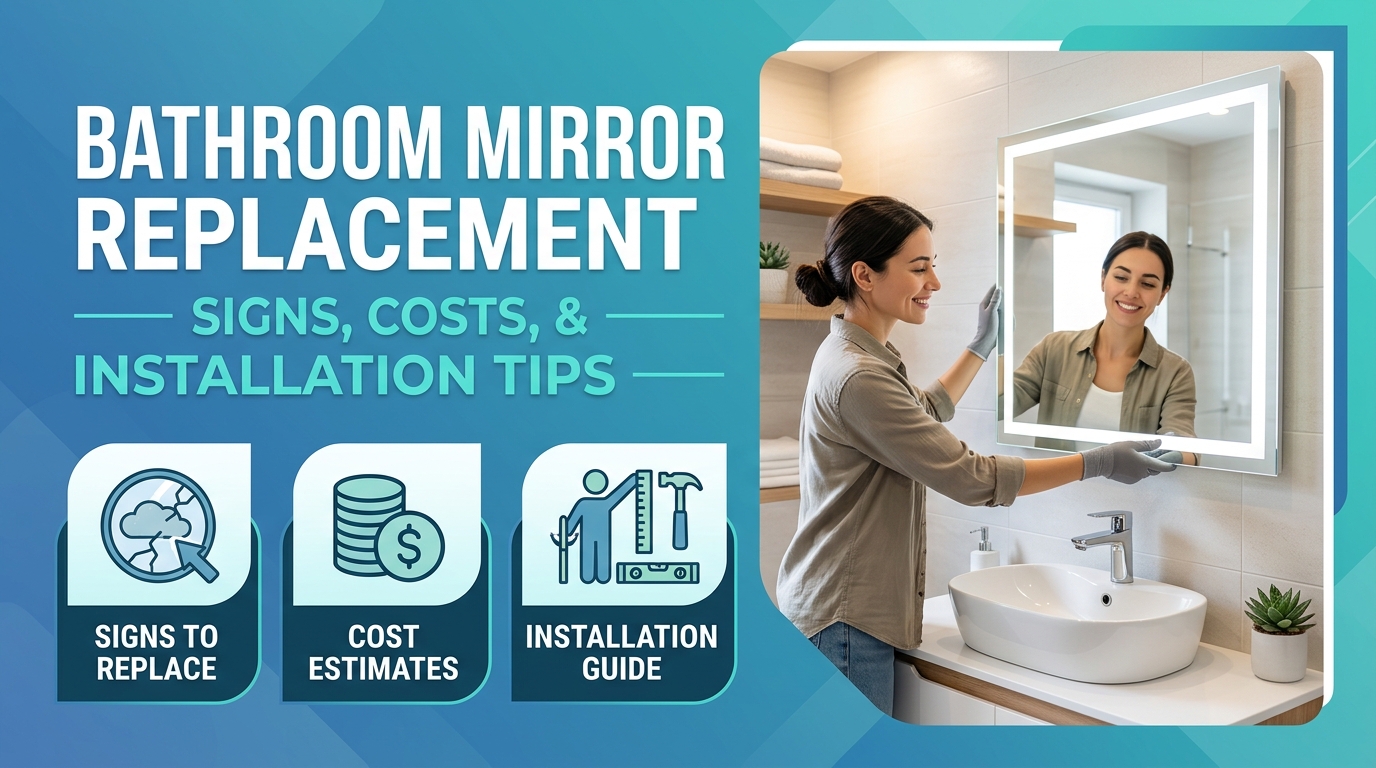
Bathroom Mirror Replacement: Signs, Costs, and Installation Tips
A bathroom mirror supports daily routines, reflects light, and helps the room feel finished. When the glass is damaged, the reflective coating fails, or the size no longer works, bathroom mirror replacement may be the most practical solution.
This guide explains when to replace a mirror, the costs to consider, how professionals handle removal and installation, and what to plan before requesting an estimate in the Greater Portland area.
7 Signs It Is Time to Replace Your Bathroom Mirror
Some mirror problems are cosmetic, while others affect safety or secure mounting. Look for these common signs:
- Cracks, chips, or damaged edges
Even a small crack can spread, and chipped edges may be sharp. Avoid handling damaged glass; it generally needs replacement rather than a cosmetic repair.
- Black spots or darkening around the edges
Dark patches often indicate deterioration of the reflective backing, called desilvering. Cleaning the front cannot restore failed backing, so replacement is usually the reliable answer.
- Cloudiness that does not clean away
Surface residue may clean away, but permanent haze or backing damage will not. If the reflection remains dull after careful cleaning, ask a glass professional to identify the cause.
- A loose or shifting mirror
Movement, separating adhesive, bent clips, or an unstable frame can indicate a mounting problem. Keep the area clear and arrange an inspection.
- Distortion, deep scratches, or widespread surface damage
Extensive scratching or a distorted reflection can make a mirror difficult to use. Avoid abrasive repair attempts that could cause more damage.
- A poor fit after a bathroom update
A new vanity, backsplash, lighting layout, or medicine cabinet can leave the old mirror undersized, off-center, or obstructive. Vanity mirror replacement can match the revised dimensions.
- The mirror no longer meets the property’s needs
Commercial restrooms, rentals, and homes may need a more durable, accessible, or design-specific solution. Custom sizing can accommodate double vanities or unusual walls.
Bathroom Mirror Replacement Cost: What Should You Expect?
Current national consumer guides place mirror installation cost for standard projects at approximately $140 to $470, including common combinations of mirror glass, hardware, and labor. Angi lists about $80 to $250 for a small bathroom vanity mirror installation, while HomeGuide gives a broader average of $140 to $430 for mirror installation overall.[1][2]
These are planning benchmarks, not guaranteed Portland estimates. The cost to replace bathroom mirror glass may be higher when removal, wall repair, difficult access, electrical work, or custom fabrication is involved.
Project element |
How it affects the estimate |
|
Mirror dimensions and thickness |
Larger or heavier glass increases material, handling, and support requirements. |
|
Standard or custom fabrication |
Custom shapes, cutouts, bevels, polished edges, and specialty finishes add fabrication work. |
|
Existing mounting method |
Clips and rails may be simpler to address than a mirror bonded across much of the wall. |
|
Wall condition and finish |
Torn drywall paper, old adhesive, uneven tile, or damaged backing may require repair before installation. |
|
Framed or frameless design |
Frames, channels, clips, standoffs, and concealed systems have different material and labor needs. |
|
Site access |
Tight rooms, stairs, occupied commercial spaces, and oversized panels can require more time or installers. |
|
Lighting or electrical features |
A hardwired lighted mirror may require coordination with a qualified electrical professional. |
To compare estimates fairly, ask whether the quoted bathroom mirror replacement cost includes measurement, fabrication, edgework, removal, disposal, wall preparation, mounting hardware, installation, and cleanup.
Repair, Reframe, or Replace?
If clear, undamaged glass remains securely mounted, a compatible frame may update it without removal. A professional may also be able to correct certain hardware problems.
Replacement usually makes sense for cracked, chipped, cloudy, badly scratched, desilvered, incorrectly sized, or insecure mirrors. A frame may conceal deteriorated edges, but it does not repair the coating.
Choosing the Right Replacement Mirror
Framed or frameless
A framed mirror can coordinate with cabinetry and conceal a perimeter gap. A frameless mirror offers a clean look with polished or beveled edges. Consider available space, cleaning, and mounting.
Stock size or custom-cut glass
Stock mirrors suit straightforward layouts. Custom glass can align with a wide vanity, fit between cabinets, avoid fixtures, or follow unusual dimensions. Unsquare walls and cutouts may require a professional template.
Mirror quality and application requirements
ASTM C1503-24 covers quality requirements for certain silvered flat glass mirrors but does not address safety-glazing requirements for particular applications.[3] Ask the installer to evaluate mirror type, mounting, location, and project-specific requirements.
Standard, low-iron, lighted, or specialty options
Standard clear mirror suits many vanities, while low-iron glass can reduce green tint at exposed edges. Lighted and anti-fog models may need power, compatible controls, ventilation planning, and trade coordination.
How to Measure for Bathroom Mirror Installation
Accurate measurement helps prevent an expensive remanufacture. Before ordering, record:
- The available wall width and height
- The vanity and sink centerlines
- The distance from the countertop or backsplash to the light fixture
- The locations of outlets, switches, sconces, cabinets, trim, and plumbing access panels
- Door, medicine-cabinet, and fixture swing clearances
- Wall material and any visible mounting points
Do not rely on vanity width alone. The mirror should align with the sink and cabinetry while clearing faucets, lighting, and storage. Measure at several points because walls and tile may not be square. Confirm custom dimensions after permanent finishes and relevant fixtures are in place.
How to Remove Bathroom Mirror Glass Safely
How to remove a bathroom mirror depends on whether it is held by clips, a rail, a frame, mechanical fasteners, adhesive, or a combination of systems. The mounting method may not be visible, and the glass can release suddenly once support is disturbed.
Do not attempt to remove cracked, oversized, heavy, or fully adhered mirrors. Keep the area clear and contact a glass professional. Before the appointment, remove movable items and provide a clear path.
What happens when professionals replace a glued bathroom mirror?
To replace glued bathroom mirror glass, installers protect nearby surfaces, stabilize the panel, and use controlled separation methods. Breakage and drywall damage remain possible because cured adhesive can form a permanent bond. They then evaluate the substrate and required repairs.
Bathroom mirror removal and installation may therefore take more than one visit when custom glass must be fabricated or the wall needs significant repair.
How to Replace Bathroom Mirror Glass: What Professionals Do
- Site assessment: The installer reviews dimensions, wall material, obstacles, condition, and access.
- Product selection: The glass, edge finish, backing, hardware, and attachment method are specified.
- Protection and removal: Surfaces are covered, the old mirror is stabilized and removed, and debris is handled appropriately.
- Wall evaluation: The substrate is checked for damage, unevenness, moisture concerns, or needed repairs.
- Installation: The mirror is positioned, leveled, supported, and secured using the specified system.
- Curing and review: Adhesive-mounted mirrors may need temporary support and an undisturbed cure period.
Mirror-compatible products matter. For example, Loctite PL530 is formulated for specified mirror and kitchen-and-bath applications, has material limitations, and lists a 48-hour full cure.[4] That does not make it appropriate for every mirror or wall. Installers should follow the exact adhesive, mirror, substrate, hardware, and cure instructions for the selected system.
Bathroom Mirror Installation Tips for a Better Result
- Finalize lighting first. Confirm sconce, outlet, and hardwired mirror locations before ordering glass.
- Plan for the wall, not just the mirror. Tile, drywall, plaster, masonry, and uneven surfaces require different preparation and mounting decisions.
- Use compatible materials. General construction adhesive can damage mirror backing or fail to provide the specified bond.
- Protect the edges from repeated moisture exposure. Address ventilation and avoid allowing water to collect behind or along vulnerable areas.
- Follow curing restrictions. Do not remove temporary support or expose the installation to normal bathroom conditions before the selected products allow it.
- Clean according to the mirror manufacturer’s guidance. Pilkington’s instructions for one coated mirror product recommend mild, nonabrasive detergent, a clean soft cloth, and avoiding abrasive cleaners, steel wool, and razor blades.[5]
Frequently Asked Questions
1. How much does bathroom mirror replacement cost?
Standard national installation benchmarks are roughly $140 to $470, but removal, wall repair, custom glass, and Portland labor conditions require a project-specific quote.[1][2]
2. How long does bathroom mirror installation take?
A simple installation may take one to two hours, but removal, repairs, custom fabrication, electrical coordination, and adhesive curing can extend the schedule.[2]
3. Can only the glass inside a mirror frame be replaced?
Often yes, if the frame is sound and a professional can safely measure, fabricate, and retain the new glass.
4. Can black edges or desilvering be repaired?
The damaged reflective coating generally cannot be restored by cleaning, so replacement is usually the dependable solution.
5. Can I replace a glued bathroom mirror myself?
Professional removal is the safer choice for glued, heavy, oversized, cracked, or chipped mirrors because the glass can release or break unexpectedly.
6. Can an old mirror be removed without damaging drywall?
Damage cannot be ruled out when adhesive bonds to drywall, although controlled professional removal may reduce the extent of repair.
7. What thickness should a bathroom mirror be?
Thickness depends on panel size, edge treatment, support, mounting system, and application, so it should be specified for the individual project.
8. Does a bathroom mirror need to be tempered or safety-backed?
Requirements depend on the mirror’s location, design, use, and applicable rules; a qualified professional should assess the specific installation.[3]
Conclusion
Bathroom mirror replacement is worth considering when glass is damaged, backing has deteriorated, mounting is unstable, or the old size no longer works. The best result starts with accurate measurements, an application-appropriate mirror, a compatible mounting system, and a complete estimate that accounts for removal and wall preparation as well as the new glass.
Professional Mirror and Glass Services in Portland, Oregon
Readers who need professional residential, commercial, or custom glass repair, replacement, or installation services can contact The Glass People in Portland, Oregon. The team can provide expert guidance, evaluate site-specific conditions, discuss suitable options, and prepare a project estimate for properties throughout the Greater Portland area.
General Information Disclaimer:
This article is provided for general informational purposes only. Glass requirements, product suitability, project costs, installation methods, and applicable building or safety codes may vary by property and location.
References Used
- Angi, “How Much Does Mirror Installation Cost? [2026 Data],” updated May 30, 2026.
- HomeGuide, “How Much Does It Cost to Install or Replace a Mirror? (2026),” updated August 29, 2025.
- ASTM International, ASTM C1503-24, “Standard Specification for Silvered Flat Glass Mirror”.
- Henkel/Loctite, “Loctite PL530 Mirror, Marble & Granite,” product information and technical guidance.
- Pilkington, “Pilkington Mirropane Chrome Handling and Processing Guidelines”.